Posted by pritha on August 20, 2024 at 1:11am in Blog
In this insightful video, industry experts explore the transformative impact of Zero Trust on cybersecurity, discussing its role in addressing modern security challenges. As cyber threats evolve and traditional perimeter defenses become outdated, Zero Trust emerges as a crucial strategy for protecting networks and data. The discussion delves into the reasons why Zero Trust is essential, examines its implementation across different sectors, and highlights the key success factors for organizations adopting this approach. Join us as we navigate the complexities and opportunities of Zero Trust, along with insights from leading cybersecurity professionals.
Technical Executive Summary:
Zero Trust as a Key Trend:
Zero Trust is identified as a significant shift in cybersecurity, moving from traditional perimeter defenses to identity-aware access control.
Workshops and discussions on Zero Trust have highlighted its growing influence in reshaping security frameworks.
Challenges in Current Security Models:
Current models often trust internal network interactions, which can allow access to malicious actors.
Zero Trust addresses challenges where neighbors within a network can't be trusted implicitly.
Zero Trust Implementation:
Trust should be transient and continuously evaluated rather than fixed.
Zero Trust emphasizes micro-segmentation and continuous authentication checks across users and devices.
Technological and Behavioral Integration:
Zero Trust requires holistic integration of various security technologies, including SD-WAN, secure web gateways, and advanced threat detection.
Successful implementation involves collaboration between IT and security teams and cultural shifts within organizations.
Critical Capabilities:
Integration of security technologies for real-time threat detection and response.
Use of machine learning and AI to dynamically assess and adapt to evolving threats.
Success Factors:
Prioritizing Zero Trust deployment based on business-critical areas.
Ensuring compliance is naturally achieved through robust security practices rather than just checking boxes.
Human and Cultural Aspects:
Building alliances within and outside the organization is crucial to overcoming challenges.
Continuous education, awareness, and stress management are essential components for maintaining effective security leadership.
Posted by pritha on August 12, 2024 at 11:56pm in Blog
In an insightful panel discussion hosted by the CISO platform, experts converged to delve into the technical challenges and strategies associated with implementing the Digital Personal Data Protection (DPDP) Act. Moderated by Rajiv Nandwani, Global Information Security Director at BCG, the session illuminated the intricate dynamics of aligning cybersecurity practices with the DPDP requirements.
The enactment of the DPDP Act has reshaped the horizon for CISOs, emphasizing a multifaceted approach that combines legal, governance, and technical expertise. Here's a detailed exploration of the technical insights shared during this comprehensive panel discussion:
Panel Members :
Rajiv Nandwani, Global Information Security Director, BCG (moderator)
Dr. Prashant Mali, Lawyer practicing in Cyber, AI and Data Protection Law
Vijay Kumar Verma, Head Security Engineering, Reliance Jio
Dr. Jagannath Sahoo, CISO, Gujarat Fluorochemicals
Vijay Vasant Lele, Senior Technical Consultant, IBM Security
Pranay Manek, System Engineer Manager, Barracuda Networks
Key Technical Insights :
Enhanced Data Classification and Discovery:
Data Mapping: Experts stressed the importance of robust data mapping processes. Effective data discovery is crucial to identify where sensitive personal data resides across both on-premise and cloud environments. Utilizing automated tools for continuous data inventory and classification was recommended to ensure that all data processing activities are accounted for.
Pseudonymization and Anonymization: Implementing techniques such as pseudonymization and anonymization were discussed as essential for safeguarding personally identifiable information (PII) during data processing and storage.
Implementation of Security Controls and Risk Management:
Privacy by Design (PbD): Panelists highlighted the necessity of incorporating Privacy by Design and Privacy by Default from the outset of IT projects. This involves integrating privacy controls and data protection strategies throughout the design and development phases.
Vulnerability Management: Regular vulnerability assessments and penetration testing are critical to ensure system hardening. Employing real-time threat detection systems and Security Information and Event Management (SIEM) solutions were advised to proactively manage security threats.
Cross-Border Data Transfer and Localization:
Data Localization Compliance: Discussions addressed the technical intricacies of complying with data localization laws. Organizations need to develop capabilities to store and process data within geographical boundaries as stipulated by local regulations.
Cross-Border Risk Mitigation: Establishing secure cross-border data transfer protocols and implementing data encryption both in transit and at rest are pivotal to maintaining compliance and mitigating associated risks.
Consent Management and User Rights:
Advanced Consent Mechanisms: The DPDP Act requires explicit consent management mechanisms, necessitating sophisticated systems to manage, track, and document user consents effectively. Integration of user-friendly interfaces for consent withdrawal and preference management was suggested.
Data Subject Rights Automation: Automating processes to handle data subject requests—such as access, correction, deletion, and data portability—helps in efficiently managing compliance with user rights.
Incident Response and Breach Management:
Incident Response Planning: Implementing detailed incident response plans and maintaining readiness through regular drills and simulations was encouraged. These plans should integrate with legal processes to ensure timely reporting and compliance with the Act's stipulations.
Cyber Insurance and Risk Transfer: Enhancing cyber insurance policies to cover liabilities specifically associated with DPDP compliance exposures, including penalties and breach response costs, can provide financial protection and risk mitigation.
Conclusion:
The panel concluded that addressing the technical demands of the DPDP Act requires a strategic blend of advanced cybersecurity frameworks, legal understanding, and executive oversight. CISOs are urged to be proactive, using the DPDP Act as a framework to reinforce data protection architectures and foster a culture of privacy awareness throughout the organization. By embracing these technological imperatives, organizations can transform compliance from a challenge into a competitive advantage, establishing robust trust with customers and stakeholders alike.
Posted by pritha on July 25, 2024 at 9:12pm in Blog
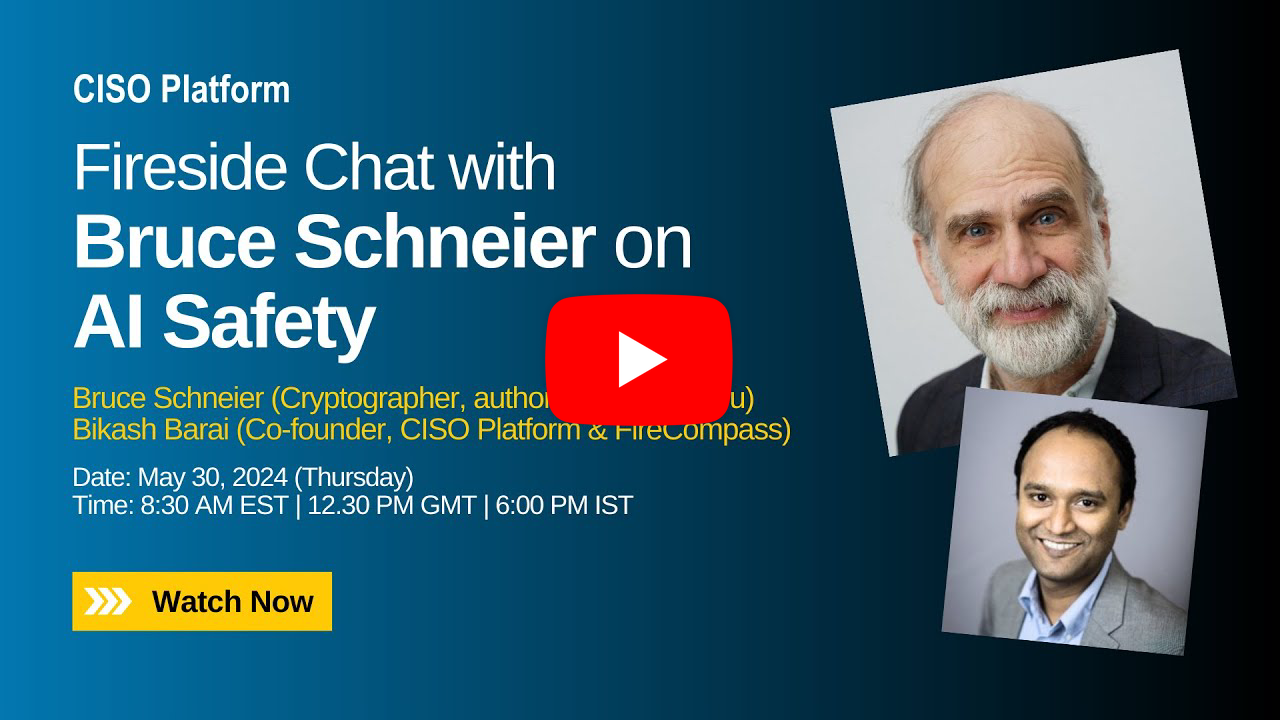
Fireside Chat On "The Future Of AI In Cybersecurity" With Bruce Schneier (Cyptographer, author & security guru) and Bikash Barai (Co-founder, CISOPlatform & FireCompass)
This blog explores the far-reaching effects of a significant IT outage at CrowdStrike, highlighting the impact on global cybersecurity operations and the lessons learned for improving resilience in the face of such disruptions. Read More
This blog outlines essential strategies for fostering a culture of privacy within organizations, emphasizing the importance of leadership, training, and transparent communication in safeguarding personal data. Read More
A comprehensive overview of key concepts and technical details of Zero Trust CNAPP (Cloud Native Application Protection Platform). The book is compiled by cloud security practitioners who specialize in the design, architecture, engineering, development, and deployment of Cloud Security solutions. We believe you will find this to be a very informative guide in your journey to implement Zero Trust Cloud Security solutions. Get Access
Upcoming Webinars & Events
If you are interested register for the upcoming meets
Gen AI Task Force - 25 July, Online (any location can join) : Register Here
Annual CISO & Founders Breakfast at BlackHat 2024 - 8 August, Las Vegas : Register Here
Top 100 Awards, 2024 .. Nominations open! : Nominate Now
Posted by pritha on May 2, 2024 at 12:29am in Blog
In the fast-paced world of cybersecurity, the role of a Chief Information Security Officer (CISO) is akin to that of a guardian of the digital realm. However, behind the scenes, this position often comes with an overwhelming burden that can lead to burnout and stress. How can CISOs effectively navigate these challenges and find balance in their professional and personal lives?
At CISOPlatform, the world’s premier online community for senior security executives, we recognize the pressing need to address CISO burnout head-on. That's why we're excited to invite you to our upcoming roundtable discussion, in partnership with FireCompass, titled "CISO Burnout & Stress Management: Addressing Through Mindfulness."
Can organizational culture impact and solve this problem?
Why are we expected to be 'always on' .. can organization culture fix it?
How can cyber maturity be best set to make a CISO worry-free?
Should companies be committed financially to a time-off/networking event? How much has this changed in recent times?
CISOs are overstretched (over-stressed hours per week, missing holidays etc)
The staffing shortage and skill gap make it harder
The ever-increasing threat and solution landscape make it harder to keep up and evolve infrastructure accordingly
Crucial areas of impact - tenure of CISO, lower engagement with other executives, less capacity to drive team. Crucial areas like hiring, customer communication, and professional development get hindered and ignored
Join Us:
Date & Time:
On 9th May 2024, Thursday 8:00 AM (PDT) @San Francisco
On 14th May 2024, Tuesday 8:00 AM (PDT) @Reston
On 15th May 2024, Wednesday 08:00 AM (PDT) @Philadelphia
Posted by pritha on April 18, 2024 at 11:35pm in Blog
Meet CISO Platform At RSA Conference 2024 (Register Here)
CISOPlatform is a global community of 5K+ Senior IT Security executives and 40K+ subscribers with the vision of meaningful collaboration, knowledge, and intelligence sharing to fight the growing cyber security threats.
CISOPlatform Breakfast Meetup @RSAC 2024 in Association with FireCompass
Topic: CISO Burnout & Stress Management: Addressing Through Mindfulness
Venue, Date & Time: St. Regis Marriott, SFO, 9th May, 2024, Thursday at 8 AM Join CISOPlatform for a breakfast meetup, where cybersecurity leaders gather to discuss the problem of CISO burnout. A big thank you to FireCompass, a partner in this community meetup.
Can mindfulness impact and solve this problem ? How do you practice mindfulness when you are expected to be "always ON"?
Register Nowlimited seats and a prior confirmation is required *
CISOPlatform Meet US @RSAC Press Room For An Exclusive Interview
Venue, Date & Time: RSA Conference, Moscone Center, SFO, Press Room, 6th to 9th May, 2024
Join us in the press room at the RSA Conference, where we'll conduct exclusive interviews with CISO's. Here is your opportunity to share your insights with 50,000+ subscribers at CISO Platform. Let's make waves together in the world of cybersecurity!
Register Now limited seats and a prior confirmation is required *
Posted by pritha on April 13, 2024 at 8:41pm in Blog
CISOPlatform Summit: Stronger Together As A Community Join us on 30th May, Thursday, Shangri-La at Bangalore CISOPlatform Summit is Asia's largest IT security conference with focus on helping the community through collaboration, making better security buying decisions and overall helping them succeed in their roles. CISOPlatform is an online social network exclusively for IT Security Professionals with 6,500+ Global CISOs and 40,000+ subscribers. Our goal is to provide highest quality information to CISOs to help them excel in their role. This conference will bring together the security community's top minds in the industry together to learn on 'benchmarking security', 'prioritising security investments', 'evaluating security products', 'task force initiatives', 'emerging fields in security & trends' & more.
Program Committee & Task Force Members
Rajiv Nandwani - Director, BCG
Nabankur Sen - Advisor, HSBC
Rajesh Thapar - CISO, Axis Bank
Sudarshan Singh - VP Group Cybersecurity Leader, Capgemini
Ambarish Singh - CISO, Godrej & Boyce Manufacturing Company
Vijay Kumar Verma - SVP and Head Cyber Security Engineering, Jio Platforms
Gowdhaman Jothilingam - Global CISO & Head IT, LatentView Analytics
Posted by pritha on February 9, 2024 at 2:37am in Blog
I am highly excited to tell you the most exciting event and all the buzz of CISOPlatform Summit is back ! Further more I am more excited because now is the time when we will receive your innovation, those billions of papers and the most exciting hacks of this year.
Below I will share a few details that could help you submit your papers-
Step 1 - Choose Your Speaking Slot
We believe in sharing knowledge which is short, great and impactful. We don't believe in restricting oneself from thoughts and sharing them, thus your talk will win the speaking slot most apt to your needs.
"Best of the World" Keynote .. This series shall invite the top speakers and security researchers across the world who made significant contribution in the field of security in recent past.
TED Style Talk (15 Minutes) .. This session aims at sharing knowledge in 15 minutes including new Insights and live Demos
Real Life Case Study (15 Minutes) .. This series encourages the Top CISOs to speak on how they implemented their most successful projects. Learning from their practical hands on insights is targeted.
CISO Tools/ Framework (15 Minutes) .. Here tools/frameworks are presented to help a CISO in better and structured decision making
Deep Dive (30 Minute) .. These sessions are workshop styled with hacking demos or short labs
Technical Trainings (1Day or 2 Day) .. If you're a security trainer, this would be a place to present your training. Profit sharing is discussed separately.
You are the best judge of which domain you are most proficient, where you have new learning, which area you are confident about. One great way to decide between multiple options can be to choose a domain you love to listen to talks or even one that can be most helpful for information security officers.
Technology
Artificial Intelligence
Secure Coding
API Security
Cloud Security (AWS, Azure..)
Application Security/ Pentesting
Security Operations Centre(SOC)
Privacy
Incident Response
Security Architecture
Threat Hunting
IoT Security
Cyber Forensics
SecDevOps
Security Management
Security Tech Landscape
CISO Board PPT/ Metrics/ Tools/ Security Posture
Cost Control
Risk Management
Vendor Management
Governance Risk and Compliance
Managing the CEO/CIO/Board expectations
Reference Architecture, Check lists and Decision Frameworks
Personal Development
Leadership
Career Growth
Entrepreneurship
Stress Management
Personal Effectiveness
Work-Life Balance/Happiness
Step 4 - Create An Awesome Topic
For this, previous year topics can always be very helpful in understanding both your best area of communication and the audience expectations. Here are a few-
Most Recent Attack Vectors Which a CISO Must Know
Analysis of Hackers Landscape in Asia and Middle - East
Analytics Driven Security
ERP Security: Attack Vectors and Defense
Lessons Learnt from the Anti-Terrorist Squad of India
Securing Mobile Banking
Global Best Practices to Defend Against Targeted Attacks
Latest Attacks Vectors and Threats on Aircrafts and Unmanned Arial Vehicles
Attacks on Smart TVs and Connected Smart Devices
Hunting Botnets: Detecting Indicators of Compromise
Step 5 - Create Your Session Abstract
Your paper is always awesome, no doubt on that. However it's always handy to know what is expected to maximize the success. Our Review Board will consist of highly experienced information security experts from all over the world. They just love geeky security and innovative technology. So, quickly write down your papers and send it to us.
Quick Tips On Content Selection -
Short and Precise .. The best communication is the sentence which is unambiguous, short and impactful. We look for similar content which appeal to human senses and is easy to understand.
Out Of The Box .. Content has no end. Yet the edge above is thought by very few. We like to encourage human nature of innovation, creativity and discovery. Such is why we are Humans not Apes!
Helpful .. Mostly sharing knowledge has a common goal of helping the infosec peers. We encourage your ideas that help the security community in solving a problem.
Trending .. Even though trending topics get the maximum competition, they also get a few more slots. These topics equip a CISO with current technologies and vulnerabilities. They are a few favorites to our audience.
Experience .. Time has been by far the best teacher. No one denies that. So, your experience can count a lot. Tell us the experience that is unique to you and also awesome. Our CISOs would lend an eager ear to that.
Technical Details .. It is highly probable your audience has the fundamentals or basics of a subject grasped. We therefore advice you to deliver your speech at an advanced level where it can be most appropriate for information security officers. For example, if you are talking about Denial-Of-Service, you may assume your audience understands the difference between DOS and DDOS and also understands most popular software mechanisms available. Our security conference cherishes more detail from its Speakers.
Step 6 - You Did It, Sit back and Relax
Great, You're done! Our review board will review the content and get back to you via mail.
P.S. - We are unable to alot speaking slot to everyone right now. We hope it's possible in future. For now our review board selects the speakers as mentioned above.
Step 7 - Declined? Ask Why
Incase we could not accept your paper this year, we are very sorry for that. However, you must know 'Why?' . Please mail us at contact@cisoplatform.com to know what went wrong. There is no reason why you should be disheartened, it is the constraints of time that bind us. We might take sometime to revert back but we will definitely do. Start afresh, keep amendments in mind and submit your proposal the year after-because most speakers get accepted eventually and we'd hate to miss you.
Step 7 - Accepted? Know Our Speaker Benefits
CISO Platform is proud to have you with us. Your comfort is our sole responsibility , your contributions will be well rewarded.
Complimentary Pass .. Complimentary pass to speakers
Address great audience .. Address the largest gathering of senior security executives
Grow your network .. Make your networking many folds in a day @Annual Summit
Showcase your profile .. Your Profile will be showcased on our website and who doesn't know the worth of 'Ted Talkers' today?
For any queries mail to contact@cisoplatform.com
Important Dates & Links
Keep forgetting? Great, the good news is it's absolutely normal and the other is there's a Google Calendar/Mobile Reminders. We hate to give dates, it's just the billions of exciting paper need to be reviewed way before the event. Please fill in your nominations prior to last date as post that no submissions will be accepted.
You can submit proposals by filling up the Call for Papers here:
Posted by pritha on January 31, 2024 at 2:56am in Blog
SACON Is Back! Pre-register to save 50%. Annual Summit & SACON Is Back ! Asia’s 1st Security Architecture Conference 30 May, Bangalore, India.
Exciting News ! Annual Summit & SACON (Security Architecture Conference) is back in 2024. We have been
Read more…
Posted by pritha on December 13, 2023 at 8:05pm in Blog
Introduction: Understanding the SolarWinds Breach and Its Fallout
The SolarWinds breach marked a turning point in the way cybersecurity is perceived and managed. As organizations grapple with the aftermath, it becomes imperative for CISOs, CIOs, and cybersecurity professionals to comprehend the legal ramifications and the challenges that lie ahead.
Meet The Experts
Matthew Rosenquist (moderator) With a staggering 35 years in the cybersecurity industry, Matthew Rosenquist brings a wealth of experience to the table. Not just a CISO, he is a cybersecurity strategist and industry adviser. His spirited moderation guides us through the legal intricacies of the SolarWinds saga.
Jim Routh (speaker) isthe Chief Trust Officer at Saviant, stands out as a luminary with over 22 years in cybersecurity leadership. Having served as CISO and board member for giants like JP Morgan Chase and KPMG, his insights promise to dissect the legal implications of the SolarWinds breach.
Michael W. Reese (speaker) is the frontline CISO of Charge EPC, brings a unique perspective with 17 years in cybersecurity. His experience as a director, CISO, and adjunct professor offers valuable insights into how legal ramifications impact the daily battles of securing organizations.
The panelists discuss the precedent set by the SolarWinds breach and its potential to drive fundamental changes in corporate policies. Highlighting the deeply ingrained nature of cybersecurity policies, the conversation addresses the empowerment of CISOs and their role in driving communications to regulatory bodies such as the SEC.
Examining the Legal Landscape: Form 8K Filings and Executive Accountability
An in-depth analysis of the legal landscape post-SolarWinds breach includes a scrutiny of Form 8K filings. The discussion raises questions about executive accountability, emphasizing the importance of transparent and honest reporting to regulatory agencies. The complexity of assigning blame and potential legal consequences are explored.
CISO Accountability: Balancing Responsibility and Collaboration
The panelists engage in a nuanced conversation about CISO accountability. While recognizing the CISO as a crucial figure in reporting cybersecurity incidents, they discuss the delicate balance between the technical content of disclosures and collaboration with legal and executive teams.
Reflections on the SEC's Enforcement Action: Impact on the Cybersecurity Industry
Delving into the SEC's enforcement action against SolarWinds and its potential consequences, the panelists express concerns about the broader impact on the cybersecurity industry. The discussion emphasizes the importance of cooperation and collaboration between regulatory agencies and the private sector for enhanced cybersecurity resilience.
Looking Ahead: Lessons Learned and Recommendations for CISOs
As the industry grapples with the fallout from SolarWinds, the panelists share insights on lessons learned and provide valuable recommendations for CISOs. The evolving role of CISOs, the need for robust identity access management, and proactive steps to strengthen cybersecurity defenses are explored.
Conclusion: Navigating the New Normal in Cybersecurity
The SolarWinds breach has undoubtedly reshaped the cybersecurity landscape. Through the lens of the insightful CISO provide a comprehensive understanding of the legal implications and CISO ramifications. As the industry adapts to these challenges, collaboration, transparency, and continuous learning emerge as the cornerstones of effective cybersecurity management.
>>Join the Cybersecurity Conversation: For deeper insights and to be part of the ongoing cybersecurity discourse, join CISO Platform - the cybersecurity community. Sign up here.
Posted by pritha on December 11, 2023 at 9:23pm in Blog
Introduction:
In a recent CISO Panel Discussion, cybersecurity heavyweights Matthew Rosenquist, Jim Routh, and Michael W. Reese delved into the intricacies of the SolarWinds Breach, unraveling its legal implications and the far-reaching ramifications for Chief Information Security Officers (CISOs). Let's dissect their insights, bridging the gap between the legal landscape and the practicalities faced by those safeguarding our digital realms.
About Speaker
Matthew Rosenquist (moderator) With a staggering 35 years in the cybersecurity industry, Matthew Rosenquist brings a wealth of experience to the table. Not just a CISO, he is a cybersecurity strategist and industry adviser. His spirited moderation guides us through the legal intricacies of the SolarWinds saga.
Jim Routh (speaker) isthe Chief Trust Officer at Saviant, stands out as a luminary with over 22 years in cybersecurity leadership. Having served as CISO and board member for giants like JP Morgan Chase and KPMG, his insights promise to dissect the legal implications of the SolarWinds breach.
Michael W. Reese (speaker) is the frontline CISO of Charge EPC, brings a unique perspective with 17 years in cybersecurity. His experience as a director, CISO, and adjunct professor offers valuable insights into how legal ramifications impact the daily battles of securing organizations.
Why the Buzz? Unraveling the Heated Debate:
The SolarWinds case has ignited passionate debates among CISOs, creating two distinct camps within the cybersecurity community. On one side, professionals perceive SEC actions as an undue burden on CISOs, unfairly targeting them as scapegoats. On the flip side, proponents argue that the case addresses individuals breaking the rules and being held accountable, emphasizing it doesn't impose specific security controls on public companies.
Setting the Stage: Understanding the SEC and Its Mission:
Before diving into the discourse, let's establish a foundational understanding of the SEC. As an independent federal administrative agency, the SEC's mission revolves around protecting investors and ensuring fair market practices. Their role, especially in cases like the SolarWinds Breach, is to maintain the integrity of financial markets by preventing unfair market manipulations.
Navigating the Legal Landscape: The SEC Complaint:
The discussion revolves around the 68-page SEC complaint, accessible on their website. It meticulously outlines various claims, with a particular focus on fraud. For a formal definition of fraud, Section 532 of the penal code is the go-to resource, shedding light on fraudulent activities related to official company filings.
A crucial point to emphasize here is the cornerstone principle of our justice system: the presumption of innocence until proven guilty. The burden of proof lies with the SEC prosecution, and it's essential to approach the accusations with this in mind.
Precedent-Setting Event: The Ripple Effect on the CISO Community:
Jim Routh, drawing from his extensive experience, highlights the unprecedented nature of this case. SEC actions against an individual CISO, Tim Brown of SolarWinds, set a precedent that reverberates throughout the industry. The repercussions are far-reaching, potentially dissuading talented cybersecurity professionals from taking up CISO roles due to increased personal liability concerns.
CISO Dilemma: Balancing Judgment and Accountability:
Jim delves into the two dimensions of the SEC complaint: timing and content of the notification. Corporate policies typically dictate that legal departments handle regulator notifications, introducing a layer of oversight. However, the SolarWinds case spotlights the CISO as the individual bearing accountability for these decisions, even in contradiction to established corporate protocols.
Speaker Perspective: The Seat at the Table Comes with Accountability:
Michael emphasizes a paradigm shift in the CISO community. The coveted "seat at the table" now entails heightened accountability, especially when cesos may not be covered by indemnification policies. This case serves as a stark reminder that the CISO role carries personal liability, necessitating a meticulous approach to governance, risk, and compliance.
The Impact on CISO Decision-Making: Pros and Cons:
As the panelists dissect the SEC filing, the potential consequences become evident. The case prompts a reevaluation of security questionnaires and practices, urging CISOs to move beyond mere checkbox exercises. The implications go beyond guilt or innocence, shaping the cybersecurity landscape in terms of tools, behavioral changes, and industry maturity.
Conclusion: Navigating the Changing Tides of Cybersecurity Accountability:
In the aftermath of the SolarWinds Breach, CISOs find themselves at a crossroads. The industry is witnessing a paradigm shift, with legal actions reshaping the expectations and accountability of those at the helm of cybersecurity. As the debate rages on, one thing is clear: the need for a proactive and informed approach to cybersecurity governance.
>>Join the Cybersecurity Conversation: For deeper insights and to be part of the ongoing cybersecurity discourse, join CISO Platform - the cybersecurity community. Sign up here.
Posted by pritha on December 6, 2023 at 11:03pm in Blog
Introduction
Welcome to a riveting discussion with cybersecurity maestros Dan Lohrmann, Danielle Cox, and Michael Gregg, who unravel the hottest trends shaping the cyber landscape for State Chief Information Security Officers (CISOs) in 2023. As we delve into their insights, get ready to chart a course for the future of cybersecurity that aligns with the ever-evolving digital terrain.
Meet the Experts
Dan Lohrmann - Field CISO, Presidio With a background spanning from the National Security Agency to Michigan Government, Dan brings extensive experience to the table. His journey has been marked by various roles in both state and federal government, providing a unique perspective on the challenges and successes of CISOs.
Danielle Cox - CISO, West Virginia Danielle's remarkable journey from a legal background to cybersecurity leadership showcases her adaptability and commitment to the field. As the CISO of West Virginia, she oversees the cybersecurity efforts for the state, bridging the gap between the public and private sectors.
Michael Gregg - CISO, North Dakota Michael's pivot from the private sector to state government was driven by a desire to enhance the efficiency of state operations. He's responsible for safeguarding a broad spectrum of government entities in North Dakota.
1. Navigating the Tech Wave: Automation Takes Center Stage In a world brimming with possibilities, automation emerges as the unsung hero. Michael Gregg, CISO of North Dakota, reveals how automation is key to handling the colossal task of protecting extensive environments. With a whopping 250,000 endpoints to secure, the manual approach becomes impractical. Join us as we explore the pivotal role of automation in fortifying state-level cybersecurity.
2. AI: A Double-Edged Sword Danielle Cox, CISO of West Virginia, sheds light on the excitement surrounding Artificial Intelligence (AI) in cybersecurity. From empowering automation to enhancing threat hunting capabilities, AI holds immense promise. However, Danielle doesn't shy away from addressing the challenges—misinformation, data privacy concerns, and the delicate balance between innovation and security. Discover how West Virginia is tackling these hurdles head-on.
3. The Tool Dilemma: Balancing Act for CISOs The toolbox is overflowing, and every vendor claims to have the ultimate solution. But as Dan Lohrmann, Field CISO at Presidio, points out, more isn't always better. With an abundance of tools, CISOs face the challenge of selection and integration. The allure of free trials and approvals masks the hidden cost—time. Join the discussion on finding the delicate equilibrium between innovation, security, and resource optimization.
4. Generative AI and its Implications for State Governments The advent of Generative AI brings both promise and caution. Danielle Cox delves into West Virginia's exploration of AI technologies, particularly in election information. However, she emphasizes the need to guard against bias and ensure unbiased results for citizens. Join us as we explore the potential and pitfalls of Generative AI in the public sector.
5. State-Level Cybersecurity Plans: West Virginia and North Dakota Perspectives Both West Virginia and North Dakota have cybersecurity plans, tailored to address the unique challenges of their states. Danielle Cox and Michael Gregg unveil their top priorities, from vulnerability remediation to incident management. Gain insights into their strategic approaches that can inspire your organization's cybersecurity roadmap.
6. Remote Work Realities: Striking the Balance The global shift towards remote work brings a mix of opportunities and challenges. Michael Gregg advocates for a hybrid model, valuing personal interactions alongside remote efficiency. Meanwhile, Danielle Cox shares West Virginia's predominantly remote setup and its impact on hiring in a competitive job market. Discover how these CISOs are adapting to the changing dynamics of the workplace.
Join the Cybersecurity Revolution with CISO Platform
Elevate your knowledge, network with industry leaders, and stay ahead of the curve by becoming a part of CISO Platform. Take the first step towards securing your organization's future by signing up here.
Posted by pritha on December 5, 2023 at 12:54am in Blog
We had Chennai Task Force session on "Digital Personal Data Protection (DPDP): Practical approach for CISOs" by Our community members. The bill aims to protect individual data and regulate data practices. CISOs should be aware of the new requirements to avoid penalties.
-Prabhakar Ramakrishnan (CISO, TNQ Publishing). Prabhakar is a seasoned IT professional with over 25 years of experience in the field of IT Infrastructure and Information Security. He currently serves as the CISO & General Manager - IT Infrastructure at TNQ Technologies.
-Dr. Jagannath Sahoo (CISO, Gujarat fluorochemicals). Jagannath have had the privilege of leading and enhancing the cybersecurity posture of INOX GFL, headquartered in Noida, India, Gujarat Fluorochemicals Limited (GFL), is a part of the INOXGFL Group.
Key Discussion Pointers:
1. Introduction to Data Privacy - What is data privacy - Privacy laws around the globe - DPDPA Journey
2. Understanding the New Indian DPDPA 2023 - Objectives - Principles of DPDPA - Applicability - Rights & Duties of Individuals - Principals - Legal implications/penalties
3. A practical approach to DPDPA compliance - Personal data Inventory - DPIA - Risk treatment
Physical privacy (for instance, being frisked at airport security or giving a bodily sample for medical reasons)
Surveillance (where your identity can't be proved or information isn't recorded)
Information privacy (how your personal information is handled)
2. What is data privacy?
Data Privacy: Compliance with Data protection laws and regulations. Focus on how to collect, process, share, archive and delete the data
Data Security: Measures that an organisation is taking in order to prevent any third party from unauthorized access
3. What does Personal Data mean?
According to the personal data protection bill, 'Personal data' refers to information, characteristics, traits or attributes that can be used to identify an individual. This includes:
Financial data
Biometric data
Data about caste, religious or political beliefs
Any other category of data specified as personal by the government
4. Data Protection and Privacy Acts World Wide
5. Rights of Individuals under the Digital Personal Data Protection Act 2023. The DPDP Act proposes the rights to individuals, which ensures that their personal data is processed with their consent and there are measures available to safeguard their data.
Right to Information about Personal data
Right to correction, completion, Updation and erasure of personal data
Right of Grievance redressal
Right to nominate
6. Structure of DPDPA Act 2023
7. Applicability of the Bill
The Bill is intended to apply to processing of personal data within the territory of India by Indian data fiduciaries and data processors. Further, the Draft Bill is also intended to apply to foreign data fiduciaries and data processors, where personal data is processed by them in connection with:
Any business carried on in India; or
For systematic activity of offering goods or services to data principals within the territory of India; or
Any activity which involves profiling of data principals within India
8. Compliance & Best Practices - 8 Steps to DPDP Act Compliance
Appoint a DPO
Create a Privacy Management Program
Conduct a Privacy Impact Assessment
Implement Data Protection Policies and Procedures
Train Employees and Partners
Monitor and Review Compliance
Respond to Data Subject Requests
Report Data Breaches
- 5 Best Practices for Data Protection
Practice Data Minimization
Securely Dispose of Data
Encrypt Sensitive Data
Implement Access Controls
Regularly update security measures
9. What you can do to prepare for the Digital Personal Data Protection Bill 2023
Posted by pritha on November 29, 2023 at 11:59pm in Blog
In the fast-evolving landscape of cybersecurity, staying informed about recent breaches and understanding their legal implications is crucial for security professionals. In this blog post, we delve into the SolarWinds breach, examining the legal facets and the potential ramifications for Chief Information Security Officers (CISOs) and their organizations.
Panelists
Matthew Rosenquist (moderator) With a staggering 35 years in the cybersecurity industry, Matthew Rosenquist brings a wealth of experience to the table. Not just a CISO, he is a cybersecurity strategist and industry adviser. His spirited moderation guides us through the legal intricacies of the SolarWinds saga.
Jim Routh (speaker) isthe Chief Trust Officer at Saviant, stands out as a luminary with over 22 years in cybersecurity leadership. Having served as CISO and board member for giants like JP Morgan Chase and KPMG, his insights promise to dissect the legal implications of the SolarWinds breach.
Michael W. Reese (speaker) is the frontline CISO of Charge EPC, brings a unique perspective with 17 years in cybersecurity. His experience as a director, CISO, and adjunct professor offers valuable insights into how legal ramifications impact the daily battles of securing organizations.
We would like to thank our speakers and community Partner FireCompass for supporting the webinar. FireCompass is recognized as a leader by Gartner in Continuous Pen Testing, Red Teaming and Attack Surface Management. FireCompass is trusted by Top 10 Telcos, Fortune 500 companies and also mid market companies.
Panel (Recorded)
The discussion begins with a closer look at the charges filed against SolarWinds. Each speaker offers unique perspectives on what the SEC complaint entails. There's a focus on the legal requirements for public companies, emphasizing the SEC forms (S1, S8, 8K) and the obligation to provide accurate and timely information to investors. The nuances of how the SEC perceives intentional deception by the company and the CISO are explored, setting the stage for a comprehensive understanding of the legal intricacies.
Corporate Policies vs. SEC Guidelines: A Delicate Balancing Act
Jim Routh adds valuable insights by highlighting the corporate policies that often dictate the process of notifying regulators. The conversation navigates through the role of legal departments and the responsibilities they bear in the face of security incidents. The delicate balance between corporate policies and SEC guidelines is scrutinized, raising questions about who holds ultimate responsibility for the accuracy and legitimacy of the content in regulatory filings.
The Unraveling Precedent: Implications for the Industry
The panelists express concerns about the precedent set by the SEC in this case. They argue that the enforcement action might have broader consequences for the industry, potentially hindering the timely sharing of sensitive information with regulators. The discussion emphasizes the need for a cooperative approach between regulatory agencies and private enterprises to bolster cybersecurity resilience.
Understanding the Landscape
The Ever-Expanding Terrain:
Since the onset of the COVID-19 pandemic, the cybersecurity landscape has stretched beyond the confines of corporate walls, reaching into the homes of employees. This expanded terrain presents a new challenge – managing and securing a vast environment. The trio emphasizes the need for a comprehensive understanding of every asset, both inside and outside the traditional corporate infrastructure.
The Shift in Mental Paradigm:
Matthew Rosenquist emphasizes the mental shift required for CISOs. The game has changed, demanding meticulous documentation and transparency. In an era where hiding vulnerabilities is no longer an option, honesty, collaboration, and accountability become paramount.
Legal Implications and CISO Ramifications
Documenting Roles and Responsibilities:
One key takeaway is the importance of clearly documenting the roles and responsibilities of a CISO. This includes defining the extent of their authority, ensuring transparent approval processes, and facilitating seamless communication with upper management, the C-suite, and investors.
Navigating the Legal Landscape:
Jim Routh highlights the weaknesses in identity access management practices within a DevOps process, especially in the context of a cloud-first model. He stresses the necessity for enhanced controls tailored to the nuances of a cloud-based software supply chain.
Negotiating for Personal Protection:
In response to the evolving landscape, Michael W. Reese suggests that CISOs should consider negotiating clauses that allow them to have a private attorney review legal documents before public disclosures. This move seeks to address potential conflicts of interest and ensures independent legal counsel for personal protection.
Embracing Ethical Practices:
The experts advocate for a robust Ethics program, fostering an environment where potential deceptive practices are flagged early on. Having an Ethics Committee in place can provide an additional layer of scrutiny, ensuring that disclosures align with ethical standards.
Moving Forward: Advice for CISOs
Proactive Indemnification:
Jim Routh emphasizes the need for CISOs to be proactive in negotiating indemnification protections. This includes securing coverage for personal legal defense, separate from the legal representation provided to the enterprise. This proactive approach aligns with the changing dynamics in the cybersecurity landscape.
Shaping the Future CISO Role:
Michael W. Reese envisions three fundamental changes in the CISO role: enhanced identity access management processes, increased influence over security incident reporting, and a shift in focus during negotiations, where CISOs spend more time negotiating indemnification protection.
Conclusion
As we navigate the aftermath of the SolarWinds Breach, CISOs find themselves at a pivotal juncture. The path forward involves embracing transparency, negotiating for personal protection, and actively shaping the future of the CISO role. Matthew Rosenquist, Jim Routh, and Michael W. Reese provide invaluable insights, setting the tone for a new era in cybersecurity.
Join the Conversation
Ready to engage with the cybersecurity community? Join CISO Platform, where professionals gather to share knowledge, experiences, and insights. Strengthen your network, stay informed, and be part of the conversation that shapes the future of cybersecurity.
Posted by pritha on November 22, 2023 at 7:22pm in Blog
Our community members Prabhakar Ramakrishnan (CISO, TNQ Publishing) and Dr. Jagannath Sahoo (CISO, Gujarat fluorochemicals) are speaking on “Digital Personal Data Protection (DPDP): Practical Approaches For CISOs”
The bill aims to protect individual data and regulate data practices. CISOs should be aware of the new requirements to avoid penalties.
Topic : (Chennai Task Force) Digital Personal Data Protection (DPDP): Practical approach for CISOs
Request members interested in the topic to register and also share with your teams and peers who may not be in the group. It is an important topic on 'DPDP for CISOs' and very relevant at the moment.
Posted by pritha on November 16, 2023 at 8:05pm in Blog
We are hosting a community Panel discussion on "Cybersecurity Breach At SolarWinds: Legal Implications And CISO Ramifications". Panelists include Matthew Rosenquist (CISO, Eclipz.io Inc), Jim Routh (Former CISO JP Morgan & Chase, Chief Trust Officer Saviynt), Michael W. Reese (CIO | CISO Charge EPC)
You might have noticed it over the internet, the cybersecurity community is discussing on SEC Charging SolarWinds and Its CISO. In a recent move, the US Securities and Exchange Commission (SEC) has filed charges against SolarWinds and its chief information security officer (CISO) for reportedly concealing crucial information about cybersecurity vulnerabilities and risks from investors for two years prior to the revelation of a major cyberattack. It is important to understand the implications and best practices a CISO can do in their position.
Please Note : Since the speakers are across the globe, the timings might be odd. In case the time does not suit your timezone, kindly register yourself, so you can get access to the recording post-session.
Posted by pritha on November 13, 2023 at 7:22pm in Podcast
(USA Panel) What's Hot For State CISOs In 2023 - By Dan Lohrmann, Danielle Cox & Michael Gregg.
The realm of Chief Information Security Officers (CISOs) is continually evolving, and 2023 brings a fresh wave of challenges and opportunities. In this c
Read more…
Posted by pritha on November 8, 2023 at 11:28pm in Blog
If you're a Chief Information Security Officer (CISO) or a cybersecurity professional, you're undoubtedly aware of the ever-evolving landscape of data protection and privacy regulations. In recent years, India has made significant strides in this arena with the introduction of the India Privacy Act. We'll dive into the key highlights and implications of this act, and we have some renowned legal experts to guide us through the intricacies.
Meet the Experts
Our esteemed panel of experts includes:
Advocate Dr. Pavan Duggal (Supreme Court of India; Expert Authority in Cyberlaw)
Advocate (Dr.) Prashant Mali (Cyber Law and Data Protection Lawyer, Bombay High Court)
One of the most striking aspects of the India Privacy Act is its emphasis on intent. The concept of personal data breach under this act encompasses unauthorized sharing of data, whether intentional or not. This means that even unintentional data breaches can have legal repercussions. So, if you're a CISO, you must be prepared to demonstrate that you took reasonable security measures and conducted data audits to safeguard against data breaches.
2. Personal Data
The act merges sensitive personal data and personally identifiable data into one category, known as "personal data." This means that anything that identifies an individual, such as their name, health data, email ID, or IP address, falls under the purview of the act. This consolidation broadens the scope of data protection and places more responsibility on data fiduciaries and processors.
3. The Merger of Data Categories
Unlike previous laws, the India Privacy Act merges sensitive personal data and personally identifiable data into a single category – personal data. This means that any information that can identify an individual, from their name to their health data or email address, falls under this broader definition. CISOs need to be aware of the expanded scope and adapt their security measures accordingly.
Who Does the India Privacy Act Apply To?
The act casts a wide net, applying to almost every legal entity in India. Whether you're a large corporation, a startup, a healthcare provider, or a cooperative housing society, if you handle personal data, you're subject to the provisions of the act. This means that there's no escape from compliance for any organization, big or small.
Penalties and Liabilities
The India Privacy Act introduces substantial penalties for non-compliance. The fines can go up to 250 crore rupees, and they can be levied per breach or per record, depending on the severity of the data breach. The act is not lenient on organizations, and even smaller entities can face significant financial and legal consequences.
While the act does not explicitly include criminal liabilities, it does not absolve organizations from other existing laws, such as the Information Technology Act 2000 and the Indian Penal Code. Violations of these laws can lead to criminal charges, making it crucial for CISOs to ensure comprehensive compliance.
Impact on Enterprises and Startups
The India Privacy Act does not distinguish between large enterprises and startups when it comes to compliance. Both are equally bound by the act's provisions, and they must adhere to data protection regulations. This includes obtaining explicit consent for data processing, maintaining a consent management system, and providing a means for individuals to withdraw their consent.
Startups that handle sensitive data face the same level of responsibility as larger organizations. The source of the data and the scale of data processing do not exempt them from compliance. It's essential for all organizations, regardless of their size, to invest in educating their employees, developing consent management systems, and ensuring data security.
Formula for Penalties
The India Privacy Act does not specify a fixed percentage of revenue as a basis for calculating penalties, unlike the GDPR. Instead, it relies on a formula that considers factors such as the magnitude of the data breach, the nature of the data, and the level of negligence on the part of the organization. The formula is still in the process of being determined and may provide more clarity in the future.
Implications for CISOs
As a CISO, you're at the forefront of ensuring data security and compliance within your organization. Here's how the India Privacy Act will impact your role:
1. Extensive Training and Education
You'll need to invest in training and education for your team to ensure they understand the nuances of the Act. From consent management to understanding the parameters of the law, a well-informed team is your first line of defense.
2. Consent Management
Consent management will become critical. You'll need to implement consent management software that provides explicit notice and allows individuals to withdraw their consent if needed. The Act emphasizes transparency in data processing and consent, ensuring data subjects are fully aware of how their information is used.
3. Data Localization
While data localization didn't make it into the Act, the onus is on organizations to ensure data security. CISOs need to consider the potential risks and advantages of data localization in their specific contexts, even in the absence of a specific mandate.
4. Data Classification and Protection
Given the Act's broader definition of personal data, a more comprehensive approach to data classification and protection is essential. This includes stricter controls on data access and sharing, encryption, and secure data storage.
Act Now
The India Privacy Act is a game-changer in the realm of data protection and privacy. As a cybersecurity professional, it's your responsibility to understand and implement the necessary measures to ensure compliance. The magnitude of the fines and the potential repercussions for non-compliance make it imperative to act now.
To stay updated and connect with a community of like-minded cybersecurity professionals, consider joining CISO Platform, a dedicated cybersecurity community. Sign up here and be part of a network that prioritizes knowledge sharing and continuous learning.
Posted by pritha on November 7, 2023 at 12:30am in Podcast
In this enlightening Fireside Chat, Brad La Porte, a former Gartner Analyst, and Bikash Barai, Co-Founder of FireCompass, delve into the world of Continuous Security Validation and Testing. Their conversation offers valuable insights for Chief Information Security Officers (CISOs), Chief Information Officers (CIOs), Cyber Security Managers, Vulnerability Managers, and Security Analysts.
Part 2 Recap: They discuss the current state of security validation, share their thoughts on achieving a continuous security approach and Exploring the Tools: ASM, CART, and BAS >>> Read More
Fireside Chat (Recorded)
The Challenge Of Continuous Security Validation
In today's digital landscape, cybersecurity has become a top priority for organizations of all sizes. Small and medium-sized businesses (SMBs) face the same threats as larger enterprises, and attackers don't discriminate based on company size. Therefore, it's crucial for SMBs to adopt a smart approach to continuous security validation.
Brad La Porte suggests that the process remains largely the same, but the key is to "think smarter, not harder." It begins with assessing your organization's attack surface, understanding what's necessary, and eliminating what's not. Just like securing your home by locking individual doors, implementing network segmentation within your organization helps reduce the overall impact of security breaches.
The Importance Of Restrictive Policies
La Porte emphasizes the significance of having strict policies in place. These policies should control what users can access, such as URL filtering, blocking websites, and restricting administrative rights. For example, in a corporate environment, it might not be appropriate to grant social media access to every employee or allow them to have administrative privileges. Implementing multi-factor authentication, stricter password rules, and frequent password resets also add layers of security.
Open Source Tools And Consolidated Solutions
For organizations with limited budgets, La Porte suggests leveraging open-source tools. Many such tools are available, allowing SMBs to gain exposure to essential security practices without breaking the bank. As organizations mature and their budgets expand, they can consider integrating best-of-breed solutions.
Barai adds that starting with open-source tools can be an excellent way to begin the cybersecurity journey. It's a cost-effective approach for SMBs looking to strengthen their security posture. Additionally, he recommends looking for consolidated solutions that offer multiple capabilities in one package, similar to a "Swiss army knife."
Key Success Factors And Common Mistakes
La Porte reflects on key success factors and common mistakes in implementing continuous security validation. He emphasizes that the answer is unique to each organization, depending on factors like business nature, culture, budget, and alignment between financial and security goals.
Success factors include reducing the number of unsuccessful attacks (reconnaissance) by identifying and eliminating weak points and decreasing dwell time (the time attackers remain within your network) through early detection and swift response.
Reducing false positives and false negatives and focusing on reducing noise in security alerts are also essential. The goal is to find the "needle in the haystack" efficiently, which, as in the world of magic, requires continuous improvement and visibility from all angles.
Ready to join the cybersecurity community and further your knowledge? Join CISO Platform, For more insightful content and updates, stay tuned to CISO Platform!
Posted by pritha on November 7, 2023 at 12:16am in Podcast
In this Interesting Fireside Chat, in collaboration with FireCompass, two industry experts, Brad La Porte (Ex Gartner Analyst) and Bikash Barai (Co-Founder, FireCompass), bring you insights into the ever-evolving landscape of cybersecurity. They disc
Read more…




.png?profile=RESIZE_400x)
